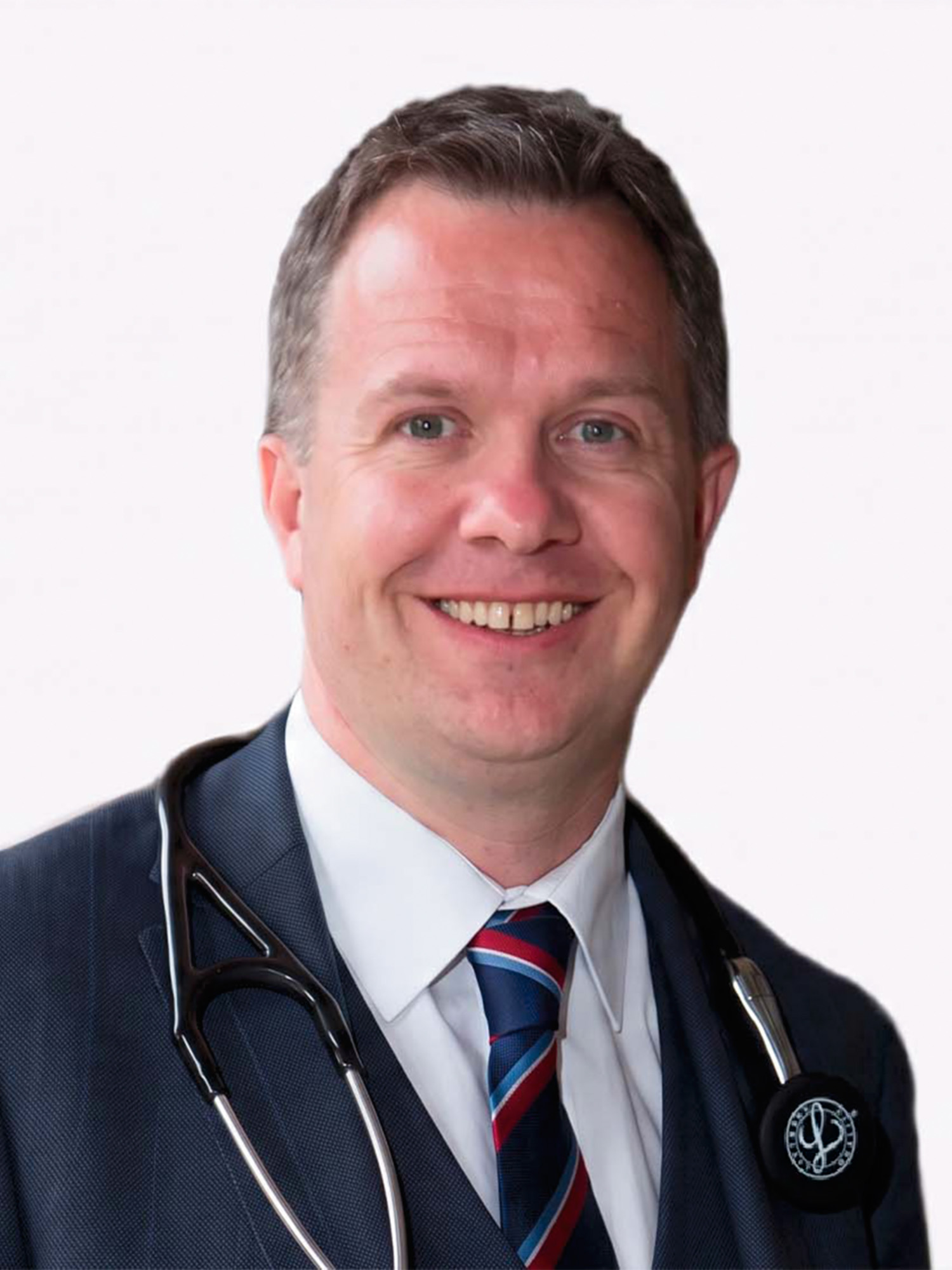
In this interview, ‘physicianeer’ Prof. Derek O’Keeffe explains how the ARC Hub harnesses Galway’s unique healthtech ecosystem to help research projects bridge the gap into the commercial world.
Academic research often proposes innovative solutions to healthcare problems, but turning those solutions into robust, investable, scalable business models requires commercial expertise. The ARC – which stands for Accelerating Research to Commercialisation – Hub was created to connect these academic projects with the necessary skillsets from the commercial world. It is co-funded by the Government of Ireland and the European Union through the ERDF Northern & Western Regional Programme 2021-2027.
Recently, the ARC Hub team sat down with Professor Derek O’Keeffe, our Thematic Lead for Advanced Wearables, to find out more about the Hub’s role in Ireland’s thriving healthtech sector. Derek, who holds dual doctorates in medicine and engineering, describes himself as a ‘physicianeer’. He is a Professor of Medical Device Technology at University of Galway, a Consultant Physician at University Hospital Galway, and the founder and director of the Health Innovation via Engineering (HIVE) Lab, which identifies clinical needs and uses state-of-the-art technology to develop innovative patient solutions. As a result, he offers a unique perspective on what it takes for academic research to make the journey into real-life medical applications.
Prof. O’Keeffe, you’ve been involved in different aspects of Ireland’s medical sector for much of your career. Why is Galway the right home for the ARC Hub for HealthTech?
Prof. O’Keeffe: I call Galway the Silicon Valley of healthtech – it’s a particularly special place for healthtech, because the university and the hospital are co-located. That’s one of our secret ingredients. The two institutions can cross-pollinate much more easily because they’re physically near each other.
Then there’s Galway’s wider ecosystem. Most of the world’s top medtech and ICT companies have offices here. For example, Dexcom, a major medtech company that has built a new facility in Athenry to make glucose monitoring devices. It’s hiring hundreds of people and investing hundreds of millions of euros. When companies invest, it creates resources and nurtures professional expertise. And now we also have the Rinn Medical Devices Centre, conducting more specialist research.
If you want to create a fertiliser to help healthtech ideas grow into successful businesses, you’ll find all the ingredients you need here in Galway.
You are what’s known as an ‘academic clinical consultant’. What kind of a difference does that make to your work, and how has embracing that concept helped make Galway’s ecosystem a ‘fertiliser’ for healthtech ideas?
Prof. O’Keeffe: An ‘academic clinical consultant’ is a doctor who has protected time for both academic work and clinical work. Again, the benefit is cross-pollination – people and organisations that normally don’t have time to interact are suddenly doing so all the time.
The benefits go both ways. Having practising doctors teaching students helps deliver better training and injects real-world experience into the university’s research work. At the same time, when I see patients and get an idea for a medical device that could help them, I’m actually able to spend time doing the research to develop it at the university.
Having that bandwidth to research and collaborate is so important. If you’re working full-time at a hospital, you just don’t have the bandwidth to go and talk about product ideas or grant applications. With the ARC Hub located at University of Galway, there is a huge opportunity to connect these different elements and turn them into a system that makes sure the best ideas become real-world solutions that help people.
How does the ARC Hub help translate ideas from the academic world into the commercial world?
Prof. O’Keeffe: The problem with academic outputs is that there are lots of great research projects, but too few translate from project to product. There’s a gulf between the academic output and the level of development that a new healthtech idea needs to be at to get commercial funding. Researchers in science, technology, engineering and medicine (STEM) have an expert skillset. But they don’t necessarily know about value propositions or market reviews. The ARC Hub’s job is to bridge that gap.
A project I’m working on – DigiStent – is a good example. Ten years ago, a patient came into the hospital with an abdominal aortic aneurysm – a bulge in the aorta. The aneurysm had recently been treated with a stent – a kind of tube that relieves the pressure and stops the bulging. Unfortunately, although stents are very effective at treating this, about a third don’t work or stop working – and that can be fatal. Sadly, that was what had happened to this patient and he died that night.
His family were very upset and said to me ‘if only he had known the stent was leaking’. They were right – if we knew the stent was failing sooner, we could have helped the patient. But a stent is just a tube. To know it’s failing, we’d need to measure the flow of blood through it.
Solving that problem required an ecosystem of expertise and a bit of gardening. The gardening came first. One day I was watering my garden, lost in thought, and I stood on the hose. What happened? The hose collapsed in my hand, because the pressure dropped. And I realised – if I could measure the pressure in my hose, or a stent, then I could measure the flow rate.
After some calculations, I realised I had an idea for an intelligent stent that measures flow. However, to translate this into a real-world solution required expertise in lots of different areas – and that’s where the ecosystem came in.
Here, I could speak to vascular surgeons and cardiologists at the hospital, and professors who specialise in sensor design, biomedical engineering and AI at the university. I also spoke to medical device companies for their manufacturing knowledge, and colleagues globally.
As a result, we’ve been able to build a prototype in just a few years. The stent is working brilliantly. It can detect a clot or leak. It’s a potentially lifesaving device – but the next step is to turn all this research and development into a market-ready solution. That’s where the ARC Hub comes in: to take this research and build it out with market analysis, IP protection, and a business value proposition – to make a great idea a commercial reality.
You mentioned that AI has played a role in making DigiStent possible. How else do you see it impacting healthtech?
Prof. O’Keeffe: What we all thought was science fiction 20 years ago – agentic AI – that’s very close to reality now. Some AI agents are as good as a postdoc. And I think that’s going to be transformative for us as a society. Traditionally, knowledge was kept inside a locked chest. Now everyone will have the same knowledge, which is empowering. The problem will be agency and judgement.
Personally, I think AI is going to make us all superpowered. I’ve done more in the last three months than in the last year due to AI.
Your work is hugely inspiring. What motivates you?
Prof. O’Keeffe: I’m curious about things and passionate about life. When you work in a hospital, you see that life is really short. Everyone thinks they get longer. Every time I inform somebody of a bad diagnosis, they always say: ‘Why me? I thought I had longer. I have so many things I want to do.’
I think it’s important to realise that you don’t actually have much time on Earth. And I think that if you want to live a full life you need to have high agency – you need to do things.
You really only have today. I think if you work in a hospital, you see that more. So I’d say curiosity, high agency, and being positive about the future and about what you do.
There’s a famous saying that if you’re doing something you love, you’re not working. It might look like I work very hard. But in another way, I never go to work.